


The Iceborne Kickstarter launches May 18, hunters. Follow now to get notified on launch!
Ready to experience your first tabletop turf war? Hope so, because it’s about to go DOWN.
For new hunters, Monster Hunter World Iceborne: The Board Game is a standalone game in the same range as Monster Hunter World: The Board Game (currently rated 8.1 on BoardGameGeek).
The two games share a lot of mechanical DNA, but Iceborne introduces some twists and different ways to play.
One such new mechanic is turf wars, where a second monster can invade your hunt, leaving you caught in a maelstrom of claws and teeth!
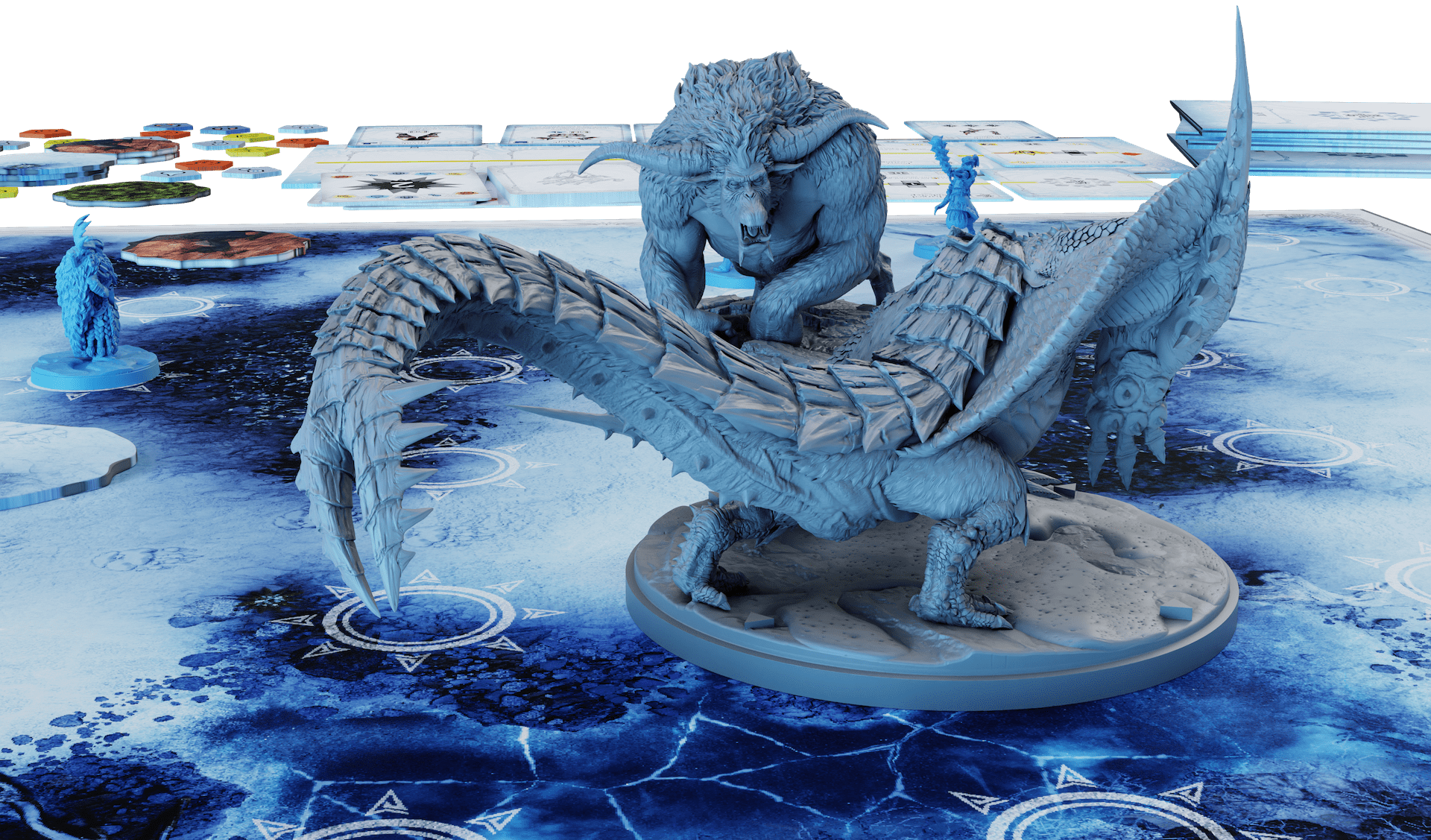
So, how do turf wars actually work? Let’s find out.
New Mechanic: Turf Wars!
from the journal of lead designer, Jamie Perkins
Most turf wars will start when you’re tracking a monster in the gathering phase*.
You might hear a spine-tingling roar in the distance that sounds nothing like the monster you’re hunting. Or maybe you’re excited to spot a track in the snow, before realising it looks… wrong.
Just like in the World board game, the decisions you make in the Iceborne gathering phase can affect the hunt ahead. Now, with turf wars, the choices you make can also determine whether your hunt will be invaded by a special guest!
If you do decide to chase down these not-so-subtle hints of a potential invader nearby, extra cards will be shuffled into the time deck. These cards will, of course, introduce the chance of a second monster crashing your party.
Once you reach the hunting phase, you’ll probably find yourself holding your breath every time someone draws from the time deck — and given that happens at the end of every hunter’s turn, there’s a very good chance you’ll be receiving an unexpected guest. The question is less ‘if’, and more ‘when’.
*For a refresher on how the gathering phase works, check out this World journal. There are some differences in Iceborne, but the basic principle is the same.

Once you’ve triggered the invading monster’s arrival and everyone’s released their collective breath, the turf war is on!
Lucky for you, you’re not the only ones this monster decided to interrupt today. This belligerent beast has been off picking fights elsewhere, so when it barrels into your arena, it will have just 50% of its starting health.
Your hunting party can then chip away at that 50% health just like you would the quest monster, i.e. the monster you actually set out to hunt. If you manage to get it down to 0, you’ve crushed its will to fight, and it will beat a hasty retreat to invade another day.
But don’t mistake this for a cake walk! Oh, no, no, no. Both the invading monster AND the quest monster are just as likely to attack you as they are each other.
So, how do you know what they’re going to target next?

Turf War Monster Targeting
If you’ve played World, you’ll know monsters decide who to target using two things: first, range, then threat value.
For those who don’t know, monster attacks typically target either the closest or furthest hunter. Every hunter also has a random threat value from 5-8 assigned at the start of the game.
In the event of a range tie, where two hunters are equidistant from the monster, the monster will always target the hunter they find the most threatening — i.e. the one with the highest threat value.
(Threat values can be swapped between hunters during a hunt, but that’s not important right now.)
Now, when it comes to turf wars, quest monsters will always treat invading monsters as if they have a threat value of 10.
(Sorry, hunters. You’ll never be quite as threatening as a rampaging Rajang.)

So, when they attack, quest monsters will still target either the closest or furthest enemy, as normal — be that a hunter or the invading monster.
But if there’s a range tie, the quest monster will always go for the invading monster, because their high threat value marks them as the priority target.
That’s why turf war behaviours look a lot like regular monster behaviour cards, because they follow a lot of the same rules:

A key difference is the complete lack of hunter symbols on the cards. This is because the turf war monster never gives the hunters the opportunity to act. Well, unless you count dodging attacks!
Eesh. So when do you get to take a turn? I’m glad you asked!
The turn order also needs to change a little to accommodate a whole extra monster.
When there’s an ongoing turf war, the invading monster goes first, then the quest monster. Then your hunters get to take turns as usual, as determined by the quest monster’s behaviour.
So, that covers you attacking the monster, and both monsters (sorry) attacking you. What about monster-on-monster attacks?
Monsters Attacking Monsters
When a monster targets another monster, it functions a lot like a hunter-on-monster attack. Let’s take another of Rajang’s turf war behaviour cards, as an example:

Lightning Blast targets the closest enemy. So, let’s say the invading monster is either the closest (range target locked) or the same distance from the monster as another, less threatening hunter (threat target locked).
Once Rajang carries out the movement as normal, it attacks from its front arc at range 2. If the other monster is in range, it will take 8 damage from a thunder elemental attack.
Now, let’s say Rajang is attacking Barioth from our previous journal, and Rajang is standing in Barioth’s front arc.

A monster attacking another monster will always target the body part with the lowest armour of the arc it’s in. In this case, it’s Barioth’s torso, which has an armour of 2.
Barioth’s armour reduces the incoming damage. So, the 8 damage from Lightning Blast is reduced by 2 armour, meaning Barioth loses 6 health.
Because Lightning Blast is a thunder elemental behaviour, Rajang will also place a thunder elemental token on Barioth’s physiology card. If this were the second thunder token to be placed there, Rajang would trigger elemental damage just like a hunter.
Status ailments work the same way. If Rajang performed a stun behaviour that damaged Barioth, it would either stick Barioth with a stun token, or stun the monster entirely.
That’s all for now, hunters. I think I hear a roar coming from the other side of that hill…
~ Journal Ends ~
We’d love to know what you think of turf wars, hunters! Let us know in the Facebook and Discord Gathering Hubs.
And we’ve still got four more monsters to encounter before we launch on May 18!
Stay frosty!


